

Day trips can be an amazing experience for children and we, as adults, need to make sure that we keep our kids as safe as possible while we are out and about. Planning ahead truly does help make the day go more smoothly. Things like wearing appropriate clothing for the weather and certain sporting activities, teaching your children about what to do if they lose sight of you and keeping a watchful eye on them at all times are just some of the ways mentioned here.

Keep Them In Sight
Always have an eye on your child or know that someone else you are with has their eye on them.
Set boundaries such as, “Stay within the playground,” or “Make sure you can still see me,” (age and maturity dependent).
Reins For Toddlers
Using reins on your child is personal choice. They can be beneficial for the child and caregiver if used correctly and safely. Here are a few reasons why caregivers may choose to use reins on their toddlers:
- Safety – Toddlers have bundles of energy and can often run off full pelt. By wearing reins, the adult can keep the child from running into roads or other hazards because toddlers do not tend to look where they are going. Reins also help to keep the child close to their adult in busy places and means the adult does not necessarily need to bend down to hold the child’s hand but can instead walk normally holding onto the reins.
- Peace of mind – Knowing that your child is nearby is good. This is especially true as above when in busy places where there is the potential to get separated from their adult.
- Independence with boundaries – The child can walk but must walk close to you. They have some independence and enjoy being allowed out of the pushchair now that they are more mobile. It fosters freedom for the child but there are still safe limits to what they can do.
- Developmental stage – Toddlers are at an age where they are becoming more aware of their surroundings but they are not yet fully aware so they often do not look where they are going and they are not fully aware of the dangers around them. They want the independence that walking gives them and they want to build up their stamina and practise these new-found walking skills and reins give them this opportunity with the adult providing the safety aspect.
- Practicality – For caregivers with multiple children, reins can help keep children all in one place when needed. They are also an easy thing to grab when you need to get your toddler quickly.
It is important to note that reins need to be used correctly and in a manner that keeps the child safe, not just to control them. Additionally, each child is different and so reins may work for one child but not for another and your choice of reins should be based on the child’s needs.
Our reins of choice are these ladybird reins:
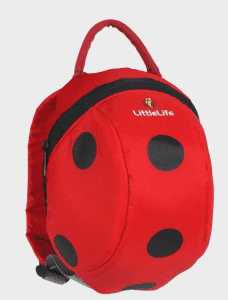
They are a little rucksack for your toddler to wear so it doubles up as handy storage for hats and sunglasses etc and the adult can hold onto a strap.
Safety Bands/Emergency Contact Info
Always make sure that somewhere on your child or in their clothing or bag is some form of emergency contact.
Depending on what age your child is, they may not be confident, able or comfortable speaking to a strange adult who is trying to help locate their parent.
We happened upon these emergency contact bands. They come in lots of different colours, you choose the font, you choose a little picture and you choose the information which goes onto it. A phone number is perfect for these bands. Our girls will, on the whole, happily wear them and every time we give them to them, we remind them of what to do if they do get lost or cannot find Mummy or Daddy.
‘Clever Never Goes’
Clever Never Goes is the replacement for Stranger Danger because most strangers will try to help your child rather than hurt them. It teaches your child to look for signs that someone is trying to take them somewhere without their parents knowing. This website has resources to help parents teach these invaluable lessons about safety skills and having the confidence to get out of a tricky situation when they are by themselves.
Remind Them To Look Every Time You Cross The Road
Teach your little ones about the green cross code – Stop, Look & Listen. Talk to them about finding a safe crossing, waiting for the green man, keeping away from the road when walking on the pavement and always looking when they cross. This can be taught from a very young age. My girls love being the one to press the button at the crossing.
They also always walk on the side of me furthest from the road, so if we cross over, they sometimes have to swap sides. Sometimes I’ll say, “Swap sides,” or they automatically do it without reminding. They are currently 4 and 2. This is so they are further from the cars passing and if one does happen to come onto the pavement, me being the more robust of us, will take the hit rather than their little, fragile bodies where more damage would potentially happen.
Go With Them To The Toilet
Go into the toilet area with your child, check the cubicle is suitable and empty and either leave them in the cubicle alone (age dependent) and wait in the handwashing area or stay in the cubicle with them.
If you are of the opposite gender to your child, take them into your toilet and chaperone them until they are of an age where you think they can go alone into their own gender’s toilets or if you believe no-one else is in the other cubicles.
If you are still worried, you could always use the disabled toilets, but I would only use this as a last resort.
Dress For The Weather
Pack sunglasses, sun hats, sun cream and shorts for hot weather.
Pack woolly hats, gloves, thick coats, waterproofs, thick boots, wellies or walking boots for winter.
This will stop your child getting sunburn or getting too cold. I would also pack spare changes of clothes in the car if you’re just not sure of what the weather will be like.
Appropriate Clothing For Sports
If you’re taking your child out on their bike or a scooter, make sure they have a bike helmet (buy this at the same time as you get them the bike). I would also model this to my child so if I were going on my bike with them, I would also be wearing a helmet. Too often I see adults cycling with no helmet but their child has one. I find this so odd.
For some activities like skateboarding, I would also require my child to wear a helmet, shin pads and elbow pads. I’d buy them at the same time as the skateboard and make it a requirement that they wear them every time they skateboard, otherwise they don’t get to skateboard.
It keeps them safe and will save any trips to the hospital (hopefully!).
Teach Them To Lie For Their Own Safety
When your kids are a little older, teach them that if they are ever alone walking down the street or at the park and someone asks where their parents or friends are, it is perfectly ok to lie to this stranger. They could point at a random person in the park and say that’s my dad or my uncle’s just in there. Make the person think that you are not alone. This clip from Instagram from Dannah Eve is where I got the idea from.
If you have any other safety advice for parents, let us know on my social media accounts.
Recent Posts
Every year, Remembrance Day is commemorated in the UK. Special parades and ceremonies are held to remember the people and animals who put their lives on the line for their country and a two-minutes...
Here's a simple and fun Remembrance Day Activity for your toddler or young child. Invite your child to put a blob of red paint on their paper. They could use a paint brush to do this or a...